Showing posts with label decorating. Show all posts

Why do some people choose a monochromatic design?
  • Fear of color
  • Unsure of how to coordinate colors
  • Easy to redecorate 
  • Likes the look of it
Here are some examples of monochromatic rooms.


While a monochromatic space may feel calming and cohesive, it can also end up looking pretty bland due to the lack of variation in color. The best way to avoid this is by playing with texture and pattern. Whether it be in the textiles, wall (paint, wallpaper or architectural detail) or the furniture itself, the mixing and matching of texture and pattern brings a lot of interest and dimension to a monochromatic room.

Here are examples of the different types of texture and patterns you can include in your design.


Below is an example of a monochromatic room using various textures and patterns to add interest back into the space.


Fur, cable knit, sequin, velvet and various shades of the same color are used in this space.
This living room has a mixture of leather, fur, satin and velvet while still sticking to the same color palette.


Here we have a cable kit and fur throw, print pillows, and pillows of varying shades of the same hue.

This space uses a blueish gray and accessorizes with fur, print and cable knit throws.
Once you've become comfortable with the mixing and matching of different textures and patterns, you will soon find yourself including it in non-monochromatic spaces as well. Give it a try. Good luck!


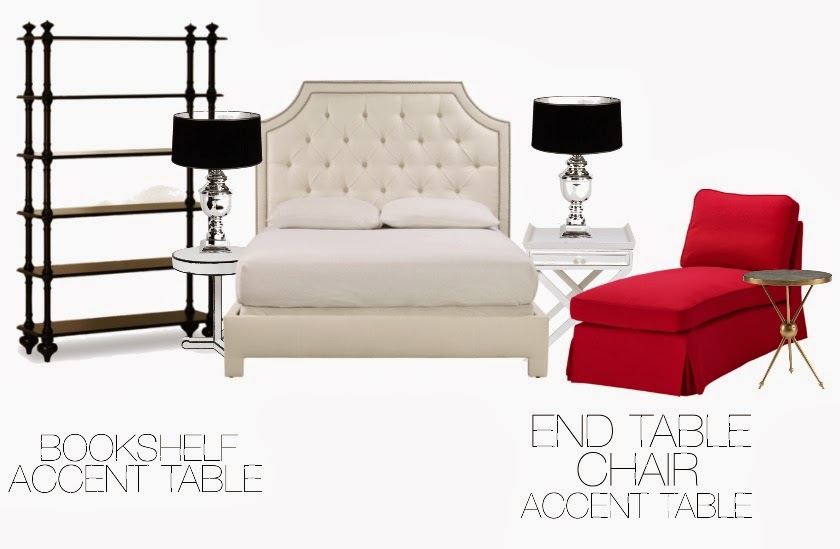
Bedside furnishing does not have to start and stop with nightstands. There are numerous ways to add character and style to your beside. Mixing and matching different pieces to create different looks and moods can really liven up a bedroom. 

Here are twelve different ways you could furnish your bedside.


The combinations are practically endless! You don't have to stick to plain ole nightstands. Have fun with it, and good luck!


Black, maroon, navy, hunter green; Dark walls can be intriguing and tempting when trying to achieve a cozy space, but they can also go terribly wrong if done improperly. Dark walls can make any room feel smaller and cozier, but it can also make the space feel daunting, heavy and cave-like. If you are going to be bold with those weighty shades there are a few ways to go about it to avoid creating a dark abyss. 

Solution: Photo and mirror galleries, lighting, and paneling.

Random Note: One of the main reasons people stick to lighter wall colors is because it's safer and easier to live with. 


  1. Break up the darkness with a contrasting photo gallery. You could argue that photo galleries can be used in any situation pertaining to wall color, light or dark, and this is true, but the key word in this case is contrasting. Meaning, the gallery you use to break up a dark wall should be lighter, therefore adding contrast and brightening the wall without taking away from it.
    • To break up the wall simply means to place some sort of color or object (photos, mirrors, lighting, etc.) on top of the preexisting wall and essentially breaking up with the flow of color on the wall.
Below are two examples of a photo gallery breaking up a dark wall.


Notice in this bedroom how two large, nearly white, pictures are used to break up that dark blue/black section of the wall. This allows you to bring back some light into the space without taking away from the dark wall.
   
       2.   Use a mirror gallery to not only break up the wall but to make the space appear larger 
             and brighter. Keep in mind that dark paint will instantly make a room appear smaller, 
             this would be a great way to reintroduce the true size of the room.


In the photo below, in addition to a wall gallery above the bed, we have two very large mirrors placed above the side dressers. Placing these large pieces in front of the table lamps will reflect more light and add a feeling of openness to the space. While these aren't considered mirror galleries, they serve the same purpose.


       3.   If the dark wall is an accent wall (An accent wall (a.k.a a "feature wall") is a wall 
             whose design differs from the design of the other walls in the room. The accent wall's
             color can simply be a different shade of the color of the other walls, or have a 
             completely different design in terms of the color and material.), shine some light on it. 
             To do so, add overhead lighting that will shine directly onto the wall, or use       
             sconces.This feature not only brightens the area but creates interest where there 
             was none.


        4.   Paneling adds both interest and structure to any wall, light or dark. Imagine a smooth 
              black wall that simply goes on forever and ever like an abyss waiting to suck and drain
              its next victim. It's boring. It's stark. It's doing nothing but existing. Because dark 
              colors are normally associated with sophistication it is easy for paneling coupled with 
              dark walls to bring sophistication into any space. It's a great way to elude the abyss 
              look.

Observe the images below. Notice how what could have been bland dark walls have turned into a thing of sophistication.


The final image below incorporates both paneling and an overhead light that illuminates the dark feature wall.


So if you're one of those individuals who likes to play it safe with light colors for fear of a heavy, boring room, these are some tips that should put your mind at easy and encourage you towards the "dark side".

Space isn't limited to the floor. Interior designers knows how to utilize the entire space of a room, including ceilings and walls.

One way to utilize space is by extending the headboard, or at least the look of the headboard. Creating the illusion of a taller headboard adds a feeling of richness and luxury to your bedroom. Tall headboards can be expensive, but they make a bedroom look and feel grand. "Extending" the headboard without actually purchasing one can create that same feel. The increased height draws the eyes upward making the room appear taller and the space more regal.

A few ways to do this is with a picture gallery, wallpaper, paint and drapery.

When using a gallery wall to extend the height of a headboard, you want to make sure that width of the gallery is similar to that of the headboard. Here are examples of a gallery extending the height of a board.

In this situation the photos are similar and symmetrical, but they don't always have to be so. The photos can be various sizes a asymmetrical, so as long as they aid in the look of a headboard.

The second way is with wallpaper

 In both spaces wallpaper has been used to extend the headboard. In the second photo especially you can see that wallpaper has been used solely as the headboard.

The third way is with paint. Painting the wall behind the headboard can have a huge impact on the overall look of the headboard.


Although the image above isn't of a bedroom, it shows the impact that paint can have when trying to extend the look of a space.

The last way you might want to consider when trying to extend the look of your headboard is by using drapery. This look not only adds luxury and height, but also a touch of romance. It's also a great way to add pops of color.


In every method the same thing is achieved, height, luxury and interest. There are many other ways to do this apart from the four mentioned, such as hanging a rug, or a large mirror, planks of wood. It's really up to you, so as long as the mission is to extend those headboard and draw attention to the height of the ceiling.

What to do when your windows are awkwardly distant from the ceiling? 

Camouflage them with blinds or roman shades.

Hanging blinds above the window sill, flushing them with the drapery rods creates the illusion that the window itself is actually taller than they actually are. So instead of hanging your blinds the traditional way, go high above the window itself. 

Here is an example of very low and short windows being made to look higher and taller.


This trick is not exclusive to low hanging windows. You can use this trick for the sake of making any window appear more grand. 

Here is an example of standard windows made to look even taller.


You may not have the finances to put in brand new windows, but you won't need it if you use this simple trick. The illusion of taller more grand windows by proper placement of blinds and drapes can add luxury and grandeur any small or mundane space.

How To Properly Hang Drapes

Too often homeowners or apartment dwellers tend to fall into the same decorating trap: hiding their lovely windows with curtains. Think of drapes as the hair on your head and the window as your face.


 Frame it, don't hide it!

You want to hang your drapes as close to the ceiling as possible and off to the sides of your window.

Exhibit A.

Exhibit B. 


Hang them HIGH and hang them WIDE!


Following these simple rules can make any window appear larger and therefore more grand.

Ideally, you want to go as high as possible, but keep the height of the ceiling in mind when hanging your drapes. If the space between the window and the ceiling is too great, causing the space to look awkward, that can be easily remedied with roman shades. This will be explained in the next post.